
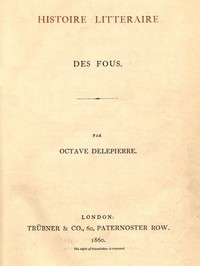
Histoire littéraire des Fous by Octave Delepierre
Published in 1860, Histoire littéraire des Fous (A Literary History of Mad People) is exactly what its title promises. Belgian archivist and writer Octave Delepierre didn't write a novel. Instead, he compiled a catalog of creativity from the edges of society. He searched through historical records, asylum archives, and obscure publications to find poems, philosophical fragments, and personal writings authored by people considered 'insane.'
The Story
There's no traditional plot. Think of it as a guided tour through a museum of forgotten minds. Delepierre acts as your curator. He introduces you to a nobleman who believed he was made of glass, a poet whose work was fueled by religious mania, and countless other individuals whose inner worlds spilled onto the page. He presents their words, often in their raw, unedited form, and provides what little biographical context he could find. The 'story' is the collective voice of these people, finally being heard after being silenced by diagnosis and institutional walls. It’s a series of windows into experiences that history usually tries to forget.
Why You Should Read It
This book stuck with me because it’s deeply human. Delepierre isn't a doctor analyzing symptoms; he’s a collector preserving art. Reading the actual words of these individuals is powerful. Some are chaotic, some are heartbreakingly clear, and others contain flashes of startling beauty. It forces you to confront your own biases. How much great thought have we lost because it made us uncomfortable? The book also quietly asks where the line is between visionary and mad, and who gets to draw that line. It’s not a light read, but it’s a compassionate one. It gives back a piece of dignity to people who were stripped of it.
Final Verdict
This is a niche but fascinating read. It’s perfect for history buffs who enjoy primary sources and untold stories, or for anyone interested in the history of psychology and mental health. Literature students will find it a unique look at unconventional creativity. It’s not for someone looking for a fast-paced narrative; it’s more of a thoughtful, sometimes challenging, anthology. If you believe that every person has a story worth telling—even, or especially, those society has cast aside—then this 19th-century act of literary archaeology is for you.
This masterpiece is free from copyright limitations. Knowledge should be free and accessible.
Elizabeth Hernandez
2 years agoAs someone who reads a lot, the emotional weight of the story is balanced perfectly. I learned so much from this.
Joseph Scott
2 years agoI had low expectations initially, however the arguments are well-supported by credible references. Exactly what I needed.
Ethan Lewis
3 months agoSimply put, the author's voice is distinct and makes complex topics easy to digest. Truly inspiring.
Robert Rodriguez
1 year agoI had low expectations initially, however the content flows smoothly from one chapter to the next. Absolutely essential reading.