
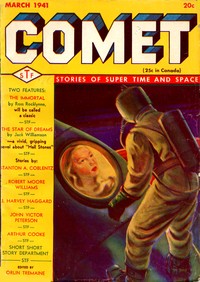
The Planet of Illusion by Donald A. Wollheim
The Story
The crew of Earth’s first interstellar ship hopes for wonder when they land on the closest exoplanet to Alpha Centauri. Instead, they get a creepily familiar copy of Washington, DC. It’s not their time—no cars, only horse-drawn carriages—and yet the people act like polite actors in a play. Every question the crew asks gets a smooth, polite brush-off. As the planet messs with their heads—showing them their own memories or forcing them into impossible choices—they soon realize they’re not explorers but prisoners inside someone else’s rehearsal. The ‘planet’ isn’t a world at all; it’s a giant projector showing their civilization a soul-test. Or is it a trap? The crew members must solve a puzzle of logic and emotion: if everyone is a copy, how do you prove which one is human—and who among them is a plant? This story was written smack in the Cold War (1958), so you get that sharp chill of people slowly realizing the thing they trust most—their senses—is fully cheated.
Why You Should Read It
What I really dig here is how Wollheim turns first-contact wonder into paranoid small talk. No ray guns, no monsters; just polite smiles and bland answers that slowly unnerve everyone. The heroine, Kathy, seems at first like a supporting character, but gets a fierce sense to fight the not-people who act like paper-thin academics. The book honors my love for vintage sci-fi that doubles as a strange mirror of *our* reality—tribalism, identity, and how easy it is for a powerful system to put a fake world in front of us. The short length catches a punch you won’t get from thousand-page epics. Also, Wollheim doesn’t overexplain; readers get trust to piece things like the creepily complete cities that nobody *inhabits*. Yes, 1950s science may make some segments sound goofy (pure hydrogen blah boom mobile), but the deep concept ages like fine Swiss cheese left out overnight—sharp, weird, completely sliceable for modern readers hoping for psychological twist.
Final Verdict
Pick this up if you fed bedtime anxiety from The Simulacra or want exact type of classic that your dad or librarian may own—dusty paper—that starts slow but tunes into real pulse. Fine for teens and adults who appreciate what authors call a ‘locked room’ mystery on a whole planet floor plan. Those looking for broad outlines about conspiracy or truth-get half the chapter where no guns fire but something tiny breaks down inside each survivor’s belief they can differentiate camera flash versus sunrise. Not hard digest; but strange twist will make you feel sour about each fake store-and-face tricked of entire crew.
This historical work is free of copyright protections. Distribute this work to help spread literacy.
Karen Miller
11 months agoThis digital copy caught my eye due to its reputation, the emphasis on ethics and sustainability within the topic is commendable. It definitely lives up to the reputation of the publisher.
Charles Anderson
3 months agoMy first impression was quite positive because the practical checklists included are a great touch for real-world use. A trustworthy resource that I'll keep in my digital library.
Matthew Jackson
11 months agoIt took me a while to process the complex ideas here, but the visual layout and supporting data make the reading experience very smooth. Simple, effective, and authoritative – what else could you ask for?
Margaret Moore
1 year agoGiven the current trends in this field, the logic behind each conclusion is easy to follow and verify. Thanks for making such a high-quality version available.