
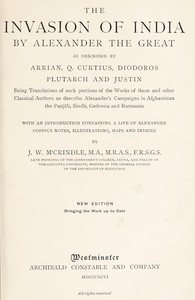
The Invasion of India by Alexander the Great as described by Arrian, Q.…
Let's set the scene. It's 326 BC. Alexander the Great has conquered the Persian Empire. He's a living legend. But he's not done. He turns his army east, toward the fabled and wealthy lands of India, a place shrouded in myth for the Greeks. This book is built around Arrian's ancient history, written centuries later but based on the lost diaries of Alexander's generals. McCrindle doesn't just translate it; he frames it, explains the geography, and untangles the confusing parts.
The Story
The 'plot' is the campaign itself. We follow Alexander's army across the Indus River into modern-day Pakistan and India. They win a massive, bloody battle against King Porus at the Hydaspes River, a fight famous for the Macedonian soldiers facing war elephants for the first time. Alexander is impressed by Porus's bravery and lets him keep his kingdom as an ally. But the story doesn't end with a neat victory. The army keeps marching east, deeper into unknown territory. The monsoon rains hit, turning the land to mud. The soldiers are exhausted, diseased, and have heard rumors of even larger armies ahead. After years of campaigning, they finally mutiny at the Hyphasis River, refusing to go further. Alexander, the undefeated commander, has to turn back. The long, grueling retreat through the Gedrosian Desert becomes a nightmare of starvation and thirst, arguably costing more lives than the battles.
Why You Should Read It
What grabbed me was the human scale of it all. Through Arrian's lens, filtered by McCrindle, you see beyond the strategic genius. You feel the soldiers' terror facing elephants, their misery in the endless rain, and their desperate courage in finally saying 'no' to their god-king. It completely reframes Alexander. This isn't just a tale of conquest; it's a story about the point where ambition crashes into reality—the reality of geography, climate, and the will of tired men. The Indian kingdoms weren't passive victims; they were formidable adversaries whose tactics and environment became Alexander's greatest opponents.
Final Verdict
Perfect for history buffs who want to get beyond the simple 'great man' narrative and into the gritty details of ancient warfare and logistics. It's also great for anyone who enjoys primary sources but wants a helpful guide. McCrindle's work is old (from the 1800s), so some historical interpretations are dated, but that almost adds to the charm—it's a classic of classical history. If you've ever wondered what it was really like at the sharp end of Alexander's spear, or why his empire stopped where it did, this is an essential and surprisingly gripping read.
This text is dedicated to the public domain. Distribute this work to help spread literacy.
James Scott
1 year agoFrom the very first page, the storytelling feels authentic and emotionally grounded. I would gladly recommend this title.





Kevin Garcia
1 year agoHigh quality edition, very readable.