
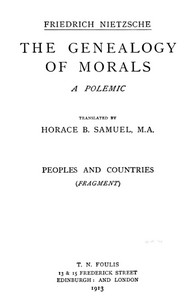
The Genealogy of Morals by Friedrich Wilhelm Nietzsche
Let's be clear: there's no plot in the traditional sense. Nietzsche isn't telling a story about characters; he's investigating the story behind our most basic values. The book is built around three long essays, each a deep dive into a pillar of Western morality.
The Story
In the first essay, Nietzsche goes hunting for the origins of 'good' and 'evil.' He finds that our current idea—where being humble, meek, and compassionate is 'good'—wasn't always around. He claims it was invented in a kind of psychological rebellion. The weak, unable to defeat the strong (whom they called 'evil'), declared their own weakness to be 'good.' It was a brilliant, resentful power grab that changed the world.
The second essay is a dark, fascinating look at guilt and bad conscience. Nietzsche suggests our inner voice, that feeling of guilt, might actually be a form of internalized cruelty. When we couldn't unleash our aggression outward, we turned it inward on ourselves. It's a startling way to think about why we sometimes feel so rotten.
The final essay asks what drives ascetics—priests, monks, people who deny themselves worldly pleasures. Nietzsche argues it's not holiness, but a deep-seated will to power expressing itself through self-denial and judging others. It's power in a spiritual disguise.
Why You Should Read It
You should read this because it forces you to question things you probably accept without thinking. Why do we value humility over pride? Is our conscience a friend or a jailer? Nietzsche's writing is fiery, poetic, and packed with insights that feel personal. He's not a dry professor; he's a provocateur in your ear, pointing out the contradictions in our moral universe. Reading him is like getting a software update for your brain—suddenly, you see the hidden code running in the background of society and in your own head.
Final Verdict
This book is perfect for anyone who loves big, challenging ideas and isn't afraid to have their foundations rattled. It's essential for philosophy curious readers, psychology enthusiasts, and anyone who's ever felt that the standard rules don't quite add up. It's not for someone looking for a simple answer or a comforting read. Nietzsche offers questions, not solutions. But if you're up for a thrilling, mind-bending intellectual workout that will change how you see history, religion, and yourself, grab this book. Just be prepared to argue with it on every page.
This title is part of the public domain archive. Share knowledge freely with the world.
Carol Perez
11 months agoSurprisingly enough, the author's voice is distinct and makes complex topics easy to digest. I learned so much from this.
Emily Perez
6 months agoI have to admit, the character development leaves a lasting impact. I will read more from this author.
Noah Johnson
1 year agoThanks for the recommendation.
Joshua Davis
3 months agoText is crisp, making it easy to focus.

Linda Jackson
2 months agoHigh quality edition, very readable.