
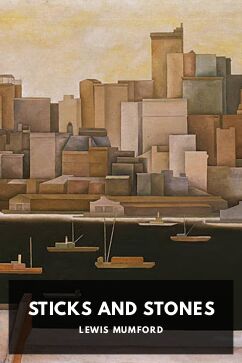
Sticks and Stones - Lewis Mumford
Let's be clear: 'Sticks and Stones' is not a textbook about old buildings. Lewis Mumford uses architecture and technology as a lens, but he's really writing a biography of human ambition. He traces how our values—from medieval spirituality to modern industrial efficiency—get physically baked into our cities, homes, and machines.
The Story
The book doesn't have a plot in the novel sense. Instead, Mumford takes us on a journey through time. He starts with organic, community-focused towns and walks us right up to the impersonal, machine-age cities of the early 20th century. He shows how the cathedral expressed a society's faith, and how the factory expressed its hunger for profit and output. The 'story' is the slow, often unnoticed, shift from building for human scale and connection to building for power, speed, and economic gain. It's the tale of how the hearth was replaced by the radiator, and the town square by the traffic interchange.
Why You Should Read It
I picked this up expecting a history lesson and got a mirror held up to my own life. Mumford's genius is making you see the familiar world as strange. After reading it, you can't unsee how a sprawling subdivision prioritizes private cars over neighborly chats, or how a sleek, windowless office building might value data over people. It gives you a vocabulary for the unease you might feel in certain spaces. He's not just complaining; he's connecting dots between our physical environment and our mental health, our sense of community, and our personal freedom. It's profoundly insightful without being preachy.
Final Verdict
Perfect for curious minds who enjoy big ideas, not just fiction fans. If you like the social observations of Malcolm Gladwell, the historical storytelling of Bill Bryson, or just wondering 'why things are the way they are,' you'll find a lot to chew on here. It's for anyone who has ever felt that our modern world, for all its gadgets and comforts, might have lost something important along the way. Mumford doesn't just diagnose the problem—he leaves you thinking deeply about what we should build next.
This masterpiece is free from copyright limitations. You are welcome to share this with anyone.
Paul Miller
1 year agoBased on the summary, I decided to read it and it manages to explain difficult concepts in plain English. A true masterpiece.






Donna Jackson
4 months agoVery helpful, thanks.