
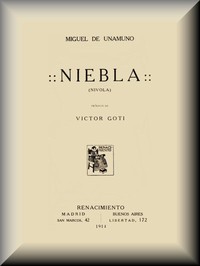
Niebla (Nivola) by Miguel de Unamuno
Miguel de Unamuno's Niebla (often called a 'nivola', his made-up word for it) is a story that starts simply and then turns completely inside out.
The Story
We meet Augusto Pérez, a young, rich, and somewhat idle man living in Spain. His life is directionless until one day, he sees a beautiful woman named Eugenia walking down the street. He becomes instantly, obsessively infatuated. Augusto's attempt to court Eugenia is clumsy and full of overthinking. She's a piano teacher with her own ambitions and a fiancé, so she mostly finds him annoying. The plot follows his awkward advances, his philosophical chats with friends, and his general confusion about life and love.
But here's where it gets wild. After a series of disappointments, Augusto decides to kill himself. Before he can do it, he has a radical thought: he needs permission from his author. He travels to Salamanca, finds Unamuno's real house, and confronts him. In an incredible scene, character and creator debate who has more power, who is more 'real', and what Augusto's fate should be. Unamuno tells Augusto he is just a fictional idea, and therefore must die as planned. The ending leaves you wondering who, exactly, won the argument.
Why You Should Read It
I picked this up expecting a period romance and got a existential brain-teaser instead, and I loved it. Unamuno writes with a dry, almost dark humor. Augusto is frustrating but you feel for him—he's a man made of thoughts and doubts, which makes his rebellion so powerful. The central question—do fictional characters have a kind of life of their own?—feels incredibly modern. It's a book about loneliness, the search for meaning, and the terrifying freedom of existing without a clear author. Reading it feels like being in on a secret joke about the nature of stories themselves.
Final Verdict
This book is perfect for readers who love metafiction and playful, philosophical novels. If you enjoyed the self-aware tricks of writers like Kurt Vonnegut or Paul Auster, you'll find Unamuno was there over a century earlier. It's also great for anyone who's ever yelled at a book because a character made a bad choice—Augusto yells back. Fair warning: it's more about ideas and conversations than fast-paced action. But if you're in the mood for a short, smart, and genuinely surprising classic that breaks all the rules, step into the Mist.
This text is dedicated to the public domain. You are welcome to share this with anyone.
George Anderson
4 months agoBeautifully written.
James Robinson
1 year agoI stumbled upon this title and the arguments are well-supported by credible references. I will read more from this author.
Michelle Brown
6 months agoAs someone who reads a lot, the arguments are well-supported by credible references. I couldn't put it down.