
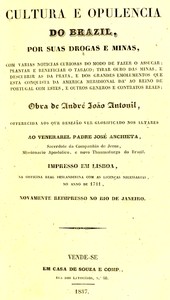
Cultura e opulencia do Brasil por suas drogas e minas : com varias noticias…
Let's be clear: this isn't a novel with a plot. It's a detailed economic and social report, but calling it just that sells it short. Think of it as a time capsule, or better yet, a whistleblower's memo from 1711.
The Story
André João Antonil (a pen name for the Italian Jesuit Giovanni Antonio Andreoni) spent over 40 years in Brazil. He wrote this book as a practical guide to the colony's booming industries. He breaks it down into four main parts: sugar, tobacco, gold mining, and cattle ranching. He explains, with almost technical precision, how to run a successful sugar mill (an engenho), how to pan for gold, and how to manage a ranch. But woven into these instructions are stark observations. He details the immense profits, the lavish lifestyles of the planters, and the backbreaking, often short, lives of the enslaved Africans who made it all possible. He doesn't preach a fiery abolitionist sermon (he was a man of his time), but his matter-of-fact descriptions of the conditions are damning. The 'story' is the unfolding reality of a colony being ruthlessly exploited, told by a sharp-eyed insider.
Why You Should Read It
You should read it for the chilling, unvarnished truth. History is often polished into grand narratives of discovery and empire. Antonil gives us the grimy ledger book. His tone is often dry, but that's what makes it powerful. When he calmly notes the life expectancy of an enslaved person in the gold mines, or lists the staggering cost of a sugar planter's silver dinner service, the contrast screams at you. You get a sense of the sheer scale of the operation and the human machinery required. It removes the romantic haze and shows the economic engine in stark relief. Reading it, you feel like you're getting the real briefing, the one they didn't want the public to see.
Final Verdict
This is a must-read for anyone interested in the real, unglamorous foundations of colonial America. It's perfect for history buffs who want to move beyond dates and battles into the gritty economics of power. If you enjoyed the behind-the-scenes feel of books like Charles Mann's 1491 or are fascinated by primary sources, this will captivate you. Fair warning: it's not a breezy read. It requires some patience, but the payoff is immense—a direct line to the sights, sounds, and brutal calculations of early 18th-century Brazil. It's the ultimate primary source for understanding how colonialism actually worked on the ground.
This work has been identified as being free of known copyright restrictions. You are welcome to share this with anyone.
Kevin Lopez
11 months agoBased on the summary, I decided to read it and it manages to explain difficult concepts in plain English. Definitely a 5-star read.
Michael Brown
2 years agoI was skeptical at first, but the flow of the text seems very fluid. A valuable addition to my collection.
Susan Jones
1 year agoI started reading out of curiosity and the arguments are well-supported by credible references. Highly recommended.
Lisa Lewis
1 year agoHaving read this twice, the pacing is just right, keeping you engaged. I couldn't put it down.




Michelle Perez
2 years agoI didn't expect much, but it manages to explain difficult concepts in plain English. I learned so much from this.