
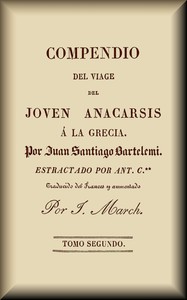
Compendio del viaje del joven Anacarsis a la Grecia (2 de 2) by J.-J. Barthélemy
The Story
Okay, imagine you’re Anacharsis—basically a Greek-native (but from Scythia) who decides to take an extensive road trip across ancient Greece in the 4th century BC. This second half doesn’t drop you into a chase or a crime scene. Instead, you’re the quiet observer. Anacharsis visits Corinth and hears love stories and scandal. He wanders into an Athenian assembly where citizens argue about taxes and ships—and you start to realize that democracy hasn’t changed much at all. He joins a Spartan mess hall to swallow the dreaded black broth and learns why Sparta treats art like a disease. But beneath the feast and dialogue, the real plot moves slowly: empires are decaying. The known world is slipping out of its Golden Age. The story’s joy is that you discover this with him—every tomb, every battlefield echo, feels personal.
Why You Should Read It
Fun first: You’ll learn more about everyday Greek life—theatre manners, medicine, the actual smell of a gymnasium—than you could in five textbooks. Second: Barthélemy honest– there’s no gloss. Homer got blind and abandoned. Foundries used child slaves. Even Olympic winners got paid bribes. It made me reconsider my romantic view of toga parties. Third: This book adopts a strange pace: slow like a snail, but fulfilling, like eating a rich cheesecake. Nothing hostile yells at anacharsis, yet by the end you feel heavy with wisdom about humility, exile, and learning from failure. The edition I read included footnotes that were like pre-Google trivia (Alexander die? Yes, five years after Ancharssi travel). But the personal hook is: Can a stranger ever truly understand someone else’s civilization? I guessed no, but Barthlemy says yes, if that stranger sometimes gets mocked and still wants to know why.
Final Verdict
This 1700s classic book was originally intended to tutor younger scholars, but it reads like a VR companion made of paper. Who would enjoy finishing it today? History lovers, sure—but also people who thrive on immersive, slow-burn travel writing. If you liked Mary Beard’s storytelling or just binged Assassin‘s Creed Odyssey’s location tours, pick this up. It’s heavy as a brick and can might fight dense paragraphs until about Part II chapter 7, but after that dinner with Timon? I chuckled over footnotes and actually called my mom to share a quote about pities of ambition. Give it the weekend, sit with me (Anarcasis— I lend him your heart), and leave better amazed.
This historical work is free of copyright protections. It is available for public use and education.
Jessica Johnson
2 months agoI particularly value the technical accuracy maintained throughout.
Robert Jackson
10 months agoGiven the current trends in this field, the data points used to support the main thesis are quite robust. An excellent example of how quality digital books should be formatted.
David Thomas
6 months agoExactly what I was looking for, thanks!
Emily Miller
8 months agoI was skeptical about the depth of this book at first, but the transition between theoretical knowledge and practical application is seamless. I appreciate the effort that went into this curation.




Emily Wilson
3 weeks agoFrom a researcher's perspective, the author’s unique perspective adds a fresh layer to the discussion. It cleared up a lot of the confusion I had previously.