
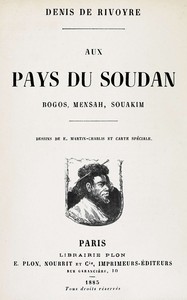
Aux pays du Soudan : Bogos, Mensah, Souakim by Denis de Rivoyre
First published in 1884, Aux pays du Soudan is Denis de Rivoyre's account of his journey through parts of what are now Sudan, Eritrea, and Ethiopia. A French correspondent, Rivoyre traveled through regions like Bogos (in the highlands), Mensah, and the critical Red Sea port of Suakin. The book is structured as a series of observations and encounters. He describes the geography, the people he meets—from local chiefs to Egyptian administrators—and the complex political scene under the crumbling rule of the Egyptian Khedivate.
The Story
There isn't a single narrative plot in the modern sense. Instead, Rivoyre takes us along on his expedition. He writes about the difficulty of travel, the beauty and harshness of the land, and the bustling trade in Suakin. He notes the tensions between local populations and the Egyptian authorities, and he observes the early stirrings of religious fervor that would soon erupt into the Mahdist War, a major rebellion against colonial control. The 'story' is the landscape itself and the snapshot of a society at a pivotal, volatile moment.
Why You Should Read It
This book won't give you thrilling action sequences. Its value is in the perspective. Rivoyre isn't a heroic explorer; he's a reporter. His writing has a matter-of-fact quality that makes the details feel real. You get the dust, the heat, the logistics of 19th-century travel. More importantly, you're seeing a region through the eyes of a European just before it was utterly transformed by war. There's an unintentional dramatic irony—we know what's coming (the fall of Khartoum, the siege of Suakin), but he doesn't. Reading his descriptions of a 'calm' Suakin, knowing it will soon be a warzone, is haunting.
Final Verdict
This is a niche but rewarding read. It's perfect for history buffs and armchair travelers who enjoy primary sources. If you've read about the 'Scramble for Africa' or the Mahdist War in general histories, this puts you on the ground right before it all happened. It's also for readers who appreciate the slow, descriptive pace of classic travel writing. Just be prepared for the 19th-century colonial mindset—it's part of the historical record, but it can be jarring. Approach it as a fascinating, flawed document from the edge of a changing world.
This is a copyright-free edition. It is available for public use and education.
Charles Jones
1 year agoIf you enjoy this genre, it manages to explain difficult concepts in plain English. I would gladly recommend this title.
Andrew Martinez
1 year agoWow.







Emma Jones
10 months agoVery helpful, thanks.