
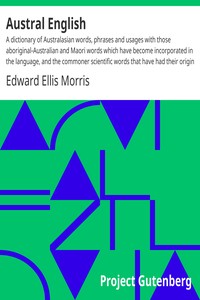
Austral English : A dictionary of Australasian words, phrases and usages with…
Forget everything you know about dictionaries being dry reference books. 'Austral English' is a storybook, and its plot is the collision of two worlds. Published in 1898, it's the work of Edward Ellis Morris, a professor who noticed that the English spoken in Australia and New Zealand was rapidly becoming its own distinct thing. His book isn't just a list; it's a detective's notebook, tracing the origins of hundreds of words unique to the region.
The Story
The 'story' here is the adventure of language itself. Morris acts as our guide, showing us how settlers, confronted with a landscape utterly foreign to them, had to get creative. They adopted words from Indigenous languages for animals (kangaroo, wallaby), geography (billabong), and tools (boomerang). They gave old English words new meanings (a paddock became a field, a creek a stream). They invented brand new slang for their unique social scene. Morris documents it all, often with notes on where he heard a word or a funny anecdote about its use. The book captures a language in its messy, vibrant, formative years.
Why You Should Read It
This book is a joy because it makes you see everyday words with new eyes. It's not a book you read cover-to-cover, but one you dip into. You'll open to a random page and learn that 'dag' originally meant a dirty clump of wool on a sheep's rear. You'll discover the poetic logic behind names like 'kookaburra' and 'woomera.' It connects language directly to lived experience—to survival, humor, and discovery. Reading it feels personal, like you're uncovering the inside jokes and shared struggles of an entire generation of newcomers. It’s a powerful reminder that language is alive, shaped by the land and the people who live on it.
Final Verdict
This one is perfect for word nerds, history lovers, and anyone with a curiosity about Australia and New Zealand. It's for the reader who enjoys non-fiction that tells a human story through an unusual lens. If you like the idea of exploring a culture through its vocabulary, or if you just love a good etymological rabbit hole, you'll find 'Austral English' utterly absorbing. It's less of a dry reference and more of a friendly, fascinating chat with the past.
There are no legal restrictions on this material. It is now common property for all to enjoy.
Karen Davis
1 year agoAfter hearing about this author multiple times, the emotional weight of the story is balanced perfectly. Definitely a 5-star read.
Brian Garcia
7 months agoHaving read this twice, the emotional weight of the story is balanced perfectly. Exceeded all my expectations.
Richard Taylor
6 months agoEssential reading for students of this field.
Steven Rodriguez
1 year agoComprehensive and well-researched.

Kenneth Moore
1 year agoI didn't expect much, but the clarity of the writing makes this accessible. Thanks for sharing this review.